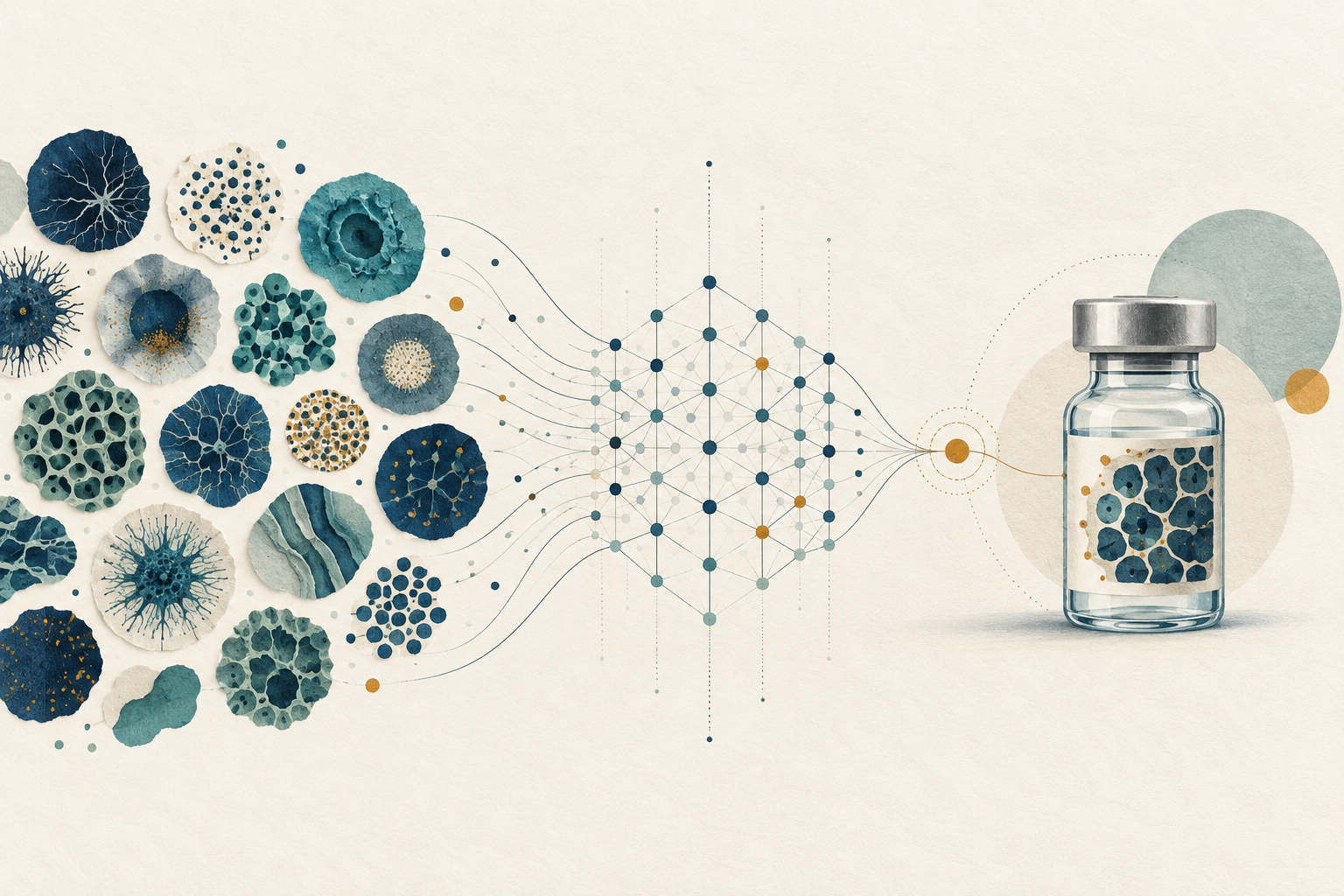
In his book "The Emperor of All Maladies: A Biography of Cancer", Siddhartha Mukherjee writes that "Cancer is not a single disease, but a collection of many diseases." Basically, unbridled cellular growth causes a whole range of effects on the patient's body. And the impact is very "personal", in that it can affect each patient differently, based on a variety of factors in their body. So treatment, too, needs to be "personalized" to be most effective. That's what AI has helped us do. Let me explain.
First, about what cancer does, broadly: an unfortunate variation of cells in the body begin to duplicate without control, creating a solid mass or "tumour". And some of those cells escape from the tumour and travel to other parts of the body, either creating new tumours or lying untriggered, for later growth. Normally, such nasty behaviour is stopped by the human immune system. But cancer cells are able to turn off the immune system's ability to attack them. So that leaves the patient open to the nastiness of cancer spreading.
There are other human conditions that cause somewhat similar situations - where cells go nuts in their behaviour. Like MS or Lupus, for example. There are now treatments for those conditions, where the drug will identify specific types of cells and help the human immune system kill them off en masse. What makes cancer so difficult to treat is the variety of cells that need to be killed: each patient's cancer-cell signature is different, so identifying them and then building a drug that targets exactly those cells is humanly impossible.
Enter AI. The use of AI here is nothing like the standard generate-a-lot-of-text-like-you-know-what-you're-saying kind of thing. The AI here is all about pattern recognition. Back when I joined my first job, during training (fresh out of college, so no real skills), our boss used to say that a key marker of human intelligence is the ability to recognize patterns. The problem with cancer cells is, though, that the variations to consider run to millions of inputs. I can look at ten different types of rackets and identify that two are tennis racquets while the rest are maybe badminton racquets. That's because I know only half a dozens types of racquets - badminton, pickleball, racquetball, squash, table tennis, tennis. How can I even begin to see a pattern if there are 4 million TYPES of racquets? That's the problem with humans being able to see patterns in a patient's blood-stream - to identify what's cancerous and what's not.
AI, OTOH, does not have that problem. Trained on millions of cell-signature patterns, it can identify variations in seconds. And it can differentiate between the healthy cells in a patient's body and the cancerous ones. Once we know how that patient's cancer cells are different, we can then design a vaccine that targets exactly those cells. Yes, designing, creating and delivering a custom vaccine is by no means easy. But COVID taught us how to do that quickly - now there's a good side-effect of the pandemic.
Designing and delivering such a custom vaccine is the idea behind "intismeran autogene", the experimental treatment Moderna is developing with Merck. The vaccine aims to teach the immune system to recognise features of that patient's cancer (the "signature", if you will). Mutations can produce altered protein fragments, called neoantigens, that provide those identifying features. The challenge is choosing which ones to use. AI helps with that selection and with turning it into a treatment that can be made for each patient.
Find the differences worth investigating
The process starts with "sequencing" data from tumour and blood samples. DNA or Genome sequencing is the process of building a "map", if you will, of a human genome. In this context, that means figuring out two things: The signature (map) of healthy cells and the signature of cancer cells in that specific patient. That's done using standard computing - no AI there, but still lots of server power. These two things are compared to create a list of what's the changed (mutated) from the regular cell to the cancer cell, so treatments can focus on cells that have those differences. Comparing sequences and applying known rules are already well-established jobs for bioinformatics software.
Next, we need to figure out which of those differences are likely to matter to the immune system. A human researcher can investigate each of those differences using scientific knowledge and experiments. But researchers cannot physically test hundreds of mutated "peptides" in a lab dish to see which ones will trigger an immune response before the cancer spreads. That would involve years of work, if even possible. AI models, on the other hand, trained on millions of physical molecular interactions, simulate the whole process in software, predicting which mutations will physically fit the patient's unique immune system and trigger killer "T-cells" to eradicate lingering cancer cells.
Finding a mutation is only the starting point. A useful target also needs to become something the immune system can recognise. AI helps connect the genetic change to that possible biological response. This is where learning from examples becomes useful. Scientists train AI models on measured biological data to predict which signatures can be destroyed by the human immune system. The model learns relationships in those examples, then applies them to new candidates. A researcher could study the same evidence, but a trained AI engine can apply those learned relationships repeatedly across a much larger candidate set much, much quicker. So researchers now know what they are looking for specifically, to build an individual treatment for that patient.
I'm of course reducing - maybe even trivializing - the complexity of the process here, just so we can understand it at a high level. The drug has to be designed, loaded onto some mechanism that will bring it to the patient's cells, tracked for impact and so on. Just making many individual batches means coordinating manufacturing capacity, quality checks, shipping and appointments. None of that is easy to do. But my point is, using computing and AI effectively brings repeatability and speed when each patient needs a different design - in a matter of days, not years.
Human planners can manage those constraints and revise schedules. The difficulty grows with the number of batches and the frequency of changes (and this is what made me go down this rabbit-hole): Moderna uses an AI scheduling algorithm within its manufacturing systems, connecting patient schedules and production activities. It automatically places batches into the available schedule and adjusts planning as circumstances change. Project management at AI scale.
So, do we have a cure for cancer yet?
The Phase 3 trial tested the treatment and produced good results. The detailed Phase 3 presentation is scheduled for 24 October at the European Society for Medical Oncology (ESMO). We're still some ways to getting this treatment into patients' hands. But it is clear that we're making progress, thanks to tech and AI.